
Beautiful Waiting Area.
Terrible Results.
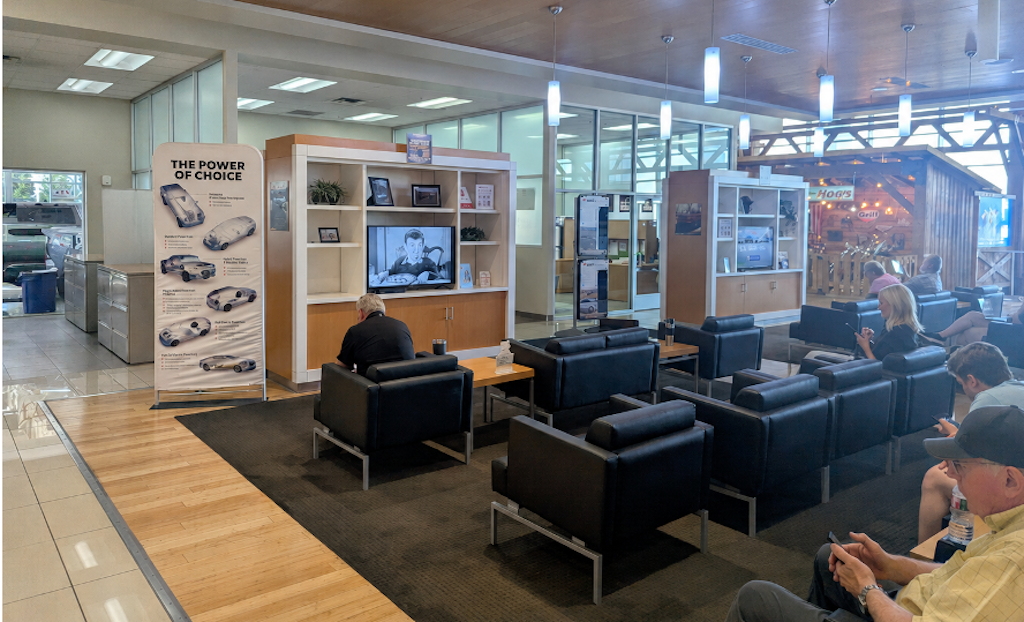
A service center can invest heavily in a beautiful waiting area and still surrender the screens to irrelevant programming, competitor advertising and customers’ phones.
You Own your Waiting Area, but Do you Own What Your Customers See?
A screen isn’t simply a way to fill time. It’s part of your customer experience, your brand and your service conversation.
Take a close look at the dealership waiting area in the photograph.
It’s clean, comfortable and thoughtfully designed. There are attractive furnishings, plenty of seating and two televisions positioned where customers can see them. On the surface, it looks like the dealership has checked every box.
Then notice what is actually happening.
All seven waiting customers visible in the photo are looking at their own screens instead of the dealership’s televisions. One TV is playing a decades-old black-and-white program. The other is showing an advertisement for a competing vehicle brand - inside their business.
That single image captures a common and expensive disconnect. They own the building, the furniture, the televisions and the customer relationship. Yet they have entirely surrendered control of the waiting area message.
If You Don’t Program the Environment, Someone Else Will
Customers will naturally reach for their phones when the room gives them no better reason to look up. That doesn’t mean your screens are obsolete. It means generic television has failed to earn attention.
A television in a service center waiting area should not be treated like a television in someone’s living room. At home, the goal may be to relax and watch a favorite show. At a service center, the screen is part of a branded business environment. It should help customers feel comfortable, understand their vehicles and recognize the value of the people serving them. It should be an intentional part of your customer communication and brand strategy.
For some service centers, the customer spends more time with the television than the employees. But cable or broadcast TV programming can introduce messages the service center would never choose to place on a wall, hand to a customer or ask a service advisor to say aloud.
The Hidden Risks of “Whatever Is On”
News can be depressing, contentious or politically divisive. General entertainment may include language, violence, sexual material or other content that is uncomfortable in a family-friendly business. Long programs are also a poor fit for customers who arrive and leave at different times. Most people will never see the beginning or the ending. And the odds of your customers being interested in that one specific program are incredibly low.
Then there are the commercials. Allowing other automotive and service center brands to advertise inside your business is the retail equivalent of inviting a competing salesperson to work the room. The ad may highlight your competitor’s pricing, warranty, newest technology, special promos, customer reviews or features. It can create comparison, doubt or buyer’s remorse at the exact moment your customer should be feeling confident about doing business with you.
There is also a licensing consideration. Consumer DVDs and personal streaming subscriptions are intended for private viewing, and commercial public display can require separate rights or agreements. We’ve seen the letters demanding high fees, and threats of lawsuits, for showing content without the proper paid licensing. Service centers should not assume that a household subscription automatically authorizes business use.
Most important, regular television does nothing to explain a brake fluid service, tire replacement, alignment, transmission service or cabin air filter. It doesn’t reinforce the professionalism of your technicians, and it doesn’t answer the customer’s quiet question: “Why does my vehicle need this?”
If customers only look at the TV for a short period of time, what do you want those moments to accomplish?
Attention Is Earned, Not Installed
Mounting a TV does not create engagement any more than placing a brochure rack creates readership. The content has to be relevant, useful and easy to enter at any moment.
That is why AutoNetTV’s Car Care Entertainment TV is built around short-form programming, and diversification of entertainment and education. Instead of asking a customer to commit to a random 30- or 60-minute show, it blends brief, family-friendly entertainment with award-winning automotive education, your service center branding, as well as any service promotions or custom messages you want to add. Customers can glance up, enjoy a segment, learn something useful and return to their phone without feeling as if they missed half the story.
The entertainment earns attention. There’s something for every customer demographic in your waiting area. Then, the car care content gives that attention targeted value – to both the customer and to your business.
Professional video increases your chances at engagement and action. It can show what a system does, why the service matters, when it may be needed and what can happen when maintenance is delayed. The information supports the advisor’s conversation without adding pressure or requiring an employee to repeat the same explanation all day.
AutoNetTV’s vehicle-owner research shows how strongly visual education can influence the customer experience:
- 97% said AutoNetTV videos increased their understanding of the service.
- 93.1% said the videos increased trust in recommendations made by employees.
- 95.7% said the videos made them more comfortable accepting service recommendations.
- 93.7% said the videos increased their willingness to obtain additional services discussed during the visit.
Those numbers point to a simple truth: customers rarely become more confident because they waited longer. They become more confident because the service center used that time to help them understand.
Take Back the Screens - and the Customer Experience
Car Care Entertainment TV gives service centers a practical way to take ownership of the waiting area. The program can display the service center’s logo, brand colors, services, promotions, certifications, community involvement and custom messages. It automatically refreshes entertainment content every two weeks, and the car care videos (based on the services you select) each month, while still allowing the service center to make changes whenever it chooses.
It also removes the content problems that come with ordinary television: competitor commercials, divisive political commentary, negative news, foul language and other material that does not belong in a professional, family-friendly environment.
But you might say that customers will still just look at their phones. True, most will. But the message is still there, and it does its job even with short bursts of attention. Read our article on a recent study that found even one second of exposure to digital screens outside of the home can begin building brand memory and influencing sales. Even in the background the message is subtle, far beyond subliminal, and builds additional layers of information reinforcement, trust building, and professionalism enhancement to your services and team members. Take, for example, the grandmother I observed while waiting in a service center at a customer location of ours that displayed Car Care Entertainment TV. She sat working on her cross stitch, without once lifting her head up to observe others entering or exiting the waiting area, or the TV programming. Then, when a video clip discussing cookware maintenance from an AutoNetTV cooking partner show began playing, she stopped her cross stitch and stared intently during the entire segment. Once finished, she went right back to her pattern. In other words, she heard the content. She was aware of what was being said – enough to completely stop her work. That means she also heard the messages about timely fluid replacement, following the manufacturer's service intervals, and how services improve the safety of her and her loved ones in her vehicle.
By contrast, consider the dealership in North Carolina who called to subscribe because they recently had to break up a disruptive argument in their waiting area between two customers – one who wanted the channel on CNN versus another who wanted it on Fox News. Or the tire dealer in Southern California who had a customer come back to the counter and cancel several additional services he agreed to shortly before because the news on TV discussed bad economic and stock market drops that made him consider his current account balances. Customers have smartphones and can get whatever they want, whenever they want, on the device in their hand. They don’t need that control over the TVs of every business they enter as well. It’s your business. It’s your message. It’s your controlled environment.
As Psy, an AutoNetTV customer in Texas, said, "I'm a store manager and I've run several stores in this area in my career. I've been here 10 to 12 years, and I have noticed a difference with the locations that have AutoNetTV. It definitely helps. The customers will come in just for an oil change, they'll see the AutoNetTV videos and they'll be like, 'Hey, I saw a video about coolant exchange - do you think my vehicle needs this?' I have definitely seen a difference. It helps because we identify as techs and try not to be "salesmen", but having that running there helps us sell more without the customers thinking we are pushing items. AutoNetTV does a really good job. It's informative and it's leading them to understand for themselves before we even come to talk with them. The videos will explain the service, then prompt the customer to come talk to an advisor. It opens the door for the conversation."
And because the program includes Content on Demand (to pause the program with the included remote control and show a service video On Demand), an advisor can use the same professional content one-on-one to support a specific recommendation right on the TV screen. The waiting-area screen becomes more than background noise. It becomes a customer engagement and education tool, and an independent voice reinforcing the service center’s expertise.
A Better Waiting Area Does More Than Help Time Pass
Service centers spend money selecting furniture, lighting, flooring, signage and amenities to shape the customer experience. The television content deserves the same level of intention.
The goal is not to force customers to stare at a screen, but to give them a reason to look up - and make every glance more useful to the customer and the dealership.
A black-and-white rerun may fill airtime. A competitor’s commercial may fill an ad break. News may make you feel like you checked the right box. But none of these helps your service center explain services, build trust or reinforce why the customer should continue to choose you. Car Care Entertainment TV does.
You already own the waiting area. Now it’s time to own what happens there.
Featured Blog Article